



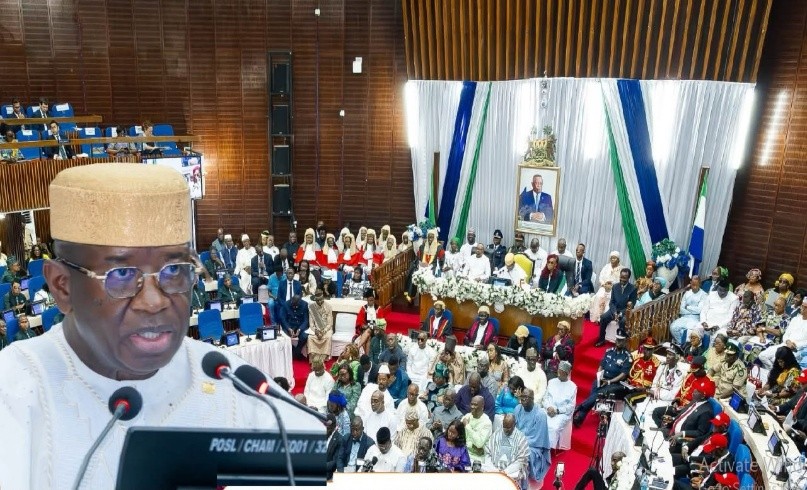
President Bio Admits Economic Strains
By Mackie M. Jalloh
President Julius Maada Bio has acknowledged that Sierra Leoneans are still facing economic pressures despite improvements in key macroeconomic indicators, insisting that the next phase of his government’s economic programme must translate national recovery into tangible relief for households.
Addressing Parliament during the State Opening on 7 August 2026, President Bio said the economy had shown signs of stabilisation despite external shocks, particularly the effects of conflicts in Ukraine and the Middle East, which have contributed to higher prices for food, fuel, fertiliser and transportation.
“Stabilisation is taking hold,” President Bio told lawmakers, while stressing that economic recovery must now be reflected in the everyday lives of citizens through lower food and transport costs, more reliable electricity, increased employment opportunities and improved public services.
The President’s assessment comes against a backdrop of persistent cost of living pressures, even as government points to stronger economic growth, falling inflation and improved fiscal and external positions.
Growth Improves, But Pressure Remains
According to the figures presented by the President, Sierra Leone’s real Gross Domestic Product grew by 4.6 percent in 2024 and increased further to 4.8 percent in 2025.
The government attributes the growth to stronger investment and increased private sector activity.
Inflation also recorded a significant decline, falling to 4.4 percent in December 2025, which the President described as the lowest level in almost two decades.
However, that progress came under pressure in 2026 as international oil prices increased. Inflation subsequently climbed to 10.8 percent in April 2026, putting renewed pressure on household budgets.
In response, government introduced temporary fuel support measures and continued subsidies on electricity tariffs in an effort to cushion consumers from rising costs.
The President also pointed to relative stability in the foreign exchange market, saying the Leone depreciated by less than one percent during 2025. He argued that the development helped protect household purchasing power and contributed to greater economic predictability.
Credit Expands as Businesses Seek Growth
The President further highlighted developments in the financial sector, including declining Treasury bill rates and a substantial increase in private-l sector lending.
Private sector credit reportedly increased by 50 percent, a development government says is creating additional room for businesses to invest, expand operations and create employment.
However, the effectiveness of this expansion will ultimately depend on whether increased access to credit reaches smaller businesses and translates into broader employment and income opportunities.
Government Revenue and Debt
On the fiscal front, President Bio said domestic revenue increased to Le18 billion, while the country’s trade deficit narrowed by approximately one-third.
He also reported a decline in public debt as a proportion of GDP, presenting the figures as evidence of progress in efforts to strengthen the country’s fiscal position.
Sierra Leone’s economic programme with the International Monetary Fund (IMF) also remains active.
The President said IMF reviews conducted in December 2025 and June 2026 resulted in disbursements of approximately US$79.8 million and US$31.7 million, respectively.
In addition, a further US$211.45 million under the IMF’s Resilience and Sustainability Facility is expected to support measures aimed at strengthening Sierra Leone’s capacity to withstand climate related economic shocks.
Development Financing Expands
Beyond IMF support, government says it secured substantial development financing during the past year.
In 2025, 12 new development agreements worth US$374.9 million reportedly became effective, while disbursements for existing development-partner projects reached US$254.4 million.
The energy sector remains one of the largest areas of planned investment.
The World Bank Group and African Development Bank are supporting Mission 300, through Sierra Leone’s National Energy Compact, which carries an estimated financing requirement of US$2.2 billion.
The government is also implementing the Power Compact with the Millennium Challenge Corporation, backed by approximately US$480.7 million from the MCC and US$14.2 million in government financing.
The projects are expected to address some of Sierra Leone’s long-standing electricity challenges while supporting economic activity and improving access to reliable power.
Partners Back Development Agenda
President Bio also acknowledged support from several international partners, including the European Union, European Investment Bank, International Fund for Agricultural Development, Islamic Development Bank, OPEC Fund, Global Fund, United Nations agencies and Denmark.
Their support covers areas including agriculture, healthcare, education, water and sanitation, digital connectivity, social protection and climate resilience.
The President pledged that government would ensure transparent management of development resources and maintain discipline in implementing donor supported programmes.
The Test: Turning Stability Into Relief
While the government’s economic indicators point to improving macroeconomic stability, President Bio recognised that ordinary citizens are ultimately more concerned about how those improvements affect their daily lives.
For households still grappling with the cost of food, transportation, electricity and other essentials, lower inflation or improved fiscal indicators may have limited meaning unless they translate into greater purchasing power and improved living standards.
President Bio therefore placed emphasis on moving beyond stabilisation towards what he described as a recovery that citizens can actually experience.
“I know how urgently our people want to feel that change,” he said.
The President’s address therefore presented Sierra Leone’s economic situation as a transition from stabilisation to recovery, with government facing the challenge of ensuring that stronger growth, improved public finances and increased development financing translate into jobs, affordable essential commodities, reliable electricity and better public services.
The coming period will consequently test whether the macroeconomic gains outlined by government can be converted into measurable improvements in household welfare while Sierra Leone continues to navigate global economic and geopolitical uncertainties.