



By Mackie M. Jalloh
The Sierra Leone Road Safety Authority (SLRSA) is preparing to intensify enforcement of the mandatory use of standard crash helmets by commercial motorbike riders and passengers, as authorities and road safety stakeholders seek to reduce the growing number of motorcycle-related deaths and serious injuries across the country.
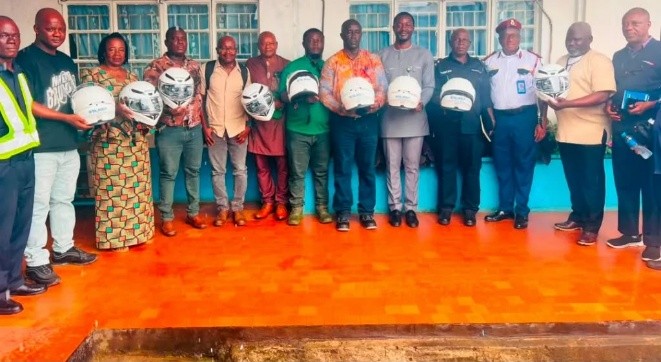
The planned nationwide enforcement campaign was at the centre of a stakeholder consultation held at the SLRSA headquarters on Kissy Road in Freetown, where government agencies, law enforcement, health authorities, civil society and representatives of commercial motorbike riders discussed ways to improve compliance with existing road safety regulations.
The engagement brought together the Sierra Leone Police, Bike Riders Union, World Health Organization (WHO) and Civil Society Movement Sierra Leone. Discussions focused on enforcement, public education, stakeholder coordination and the need to address misconceptions surrounding the use of protective helmets.
The SLRSA Executive Director, James Bagie Bio, said Sierra Leone’s road safety agenda is increasingly aligned with international efforts to reduce preventable deaths and serious injuries on the roads.
Bio referred to his participation in engagements at the United Nations General Assembly in the United States, noting that Sierra Leone is strengthening its commitment to international road safety obligations, including the implementation of the Road Safety Charter and interventions under the UN Decade of Action for Road Safety 2021–2030.
According to Bio, Sierra Leone is among five countries nominated to serve on a steering committee responsible for promoting standard helmet use and other road safety measures. He said the broader objective is to contribute to the global target of reducing road traffic fatalities and serious injuries by 50 percent by 2030.
He also praised the Sierra Leone Police for their continued cooperation with the SLRSA, stressing that effective enforcement would require sustained collaboration between institutions responsible for road safety and public order.
The World Health Organization also reaffirmed its commitment to supporting Sierra Leone’s road safety efforts.
WHO Health Promotion Officer Fredson Kuti-George described the stakeholder engagement as timely and said road safety remains a major public health concern. He pledged continued support for initiatives designed to strengthen the implementation of the UN Decade of Action for Road Safety.
For the Sierra Leone Police, the forthcoming enforcement exercise is not the introduction of a new legal requirement.
National Traffic Coordinator DSP Alimamy Koroma said the use of crash helmets is already required under Section 114 of the Road Traffic Act. He explained that the planned enforcement is intended to ensure greater compliance with the existing law and prevent avoidable deaths and life-threatening head injuries resulting from motorcycle crashes.
Koroma called for a coordinated nationwide sensitisation campaign before and alongside enforcement. He said public education should make use of radio, television, social media, community engagements and other communication platforms to ensure that both riders and passengers understand why standard helmets are necessary.
The Bike Riders Union welcomed the proposed campaign but acknowledged that compliance remains a challenge.
National President Ishmeal Sandy assured the SLRSA and police of the Union’s cooperation, while noting that helmet use is already familiar to many commercial riders. He identified resistance among some passengers and misconceptions about helmets as factors contributing to poor compliance.
Sandy’s comments highlight one of the major challenges facing enforcement authorities: ensuring that responsibility for helmet use is understood by both riders and passengers rather than placing the burden solely on commercial motorbike operators.
Civil society representatives also called for road safety interventions to be backed by reliable data.
Civil Society Movement Sierra Leone National Coordinator Juliet Anderson described helmet promotion as a collective responsibility and disclosed that her organisation is implementing an Emergency Safer Roads Initiative.
She expressed the organisation’s willingness to work with the SLRSA and other stakeholders, while emphasising the importance of collecting accurate data to determine whether road safety interventions are actually reducing injuries and deaths.
Chairing the meeting, SLRSA Deputy Executive Director Josie Abraham Scott-Manga stressed the potentially fatal consequences of motorcycle crashes, particularly where riders and passengers fail to use protective helmets.
He said severe head injuries are among the major consequences associated with motorcycle crashes and argued that stronger compliance could help prevent deaths and reduce the severity of injuries.
The consultation therefore signals a shift from general road safety awareness towards a more coordinated approach combining education, enforcement and institutional cooperation.
For the SLRSA and its partners, the challenge will be to ensure that enforcement is accompanied by sustained public engagement and that riders and passengers have access to standard protective helmets.
The authorities will also have to balance enforcement with continued sensitisation, particularly in communities where misconceptions, affordability concerns or resistance to helmet use remain widespread.
The planned nationwide campaign forms part of Sierra Leone’s broader road safety efforts and comes as authorities seek to meet national and international targets for reducing road traffic deaths.
Stakeholders agreed that effective enforcement of the helmet requirement, supported by public education, reliable data and cooperation between government agencies, civil society and transport unions, could play an important role in protecting riders and passengers.
With motorcycle transportation forming an important part of daily mobility for many Sierra Leoneans, authorities say improving helmet compliance is ultimately about more than enforcing a traffic regulation it is about preventing avoidable deaths and ensuring that people can travel without unnecessarily risking their lives.