



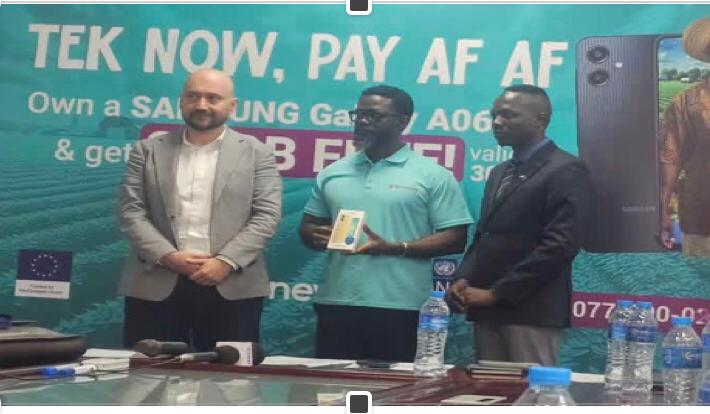
A new digital inclusion drive targeting rural livelihoods has been introduced in Sierra Leone, as AfriMoney, in collaboration with the United Nations Capital Development Fund and the European Union, rolled out a subsidised smartphone financing programme aimed at strengthening agricultural productivity through technology access.
The initiative, unveiled on April 9, 2026 at Africell Headquarters, introduces a pay-as-you-go model branded “Tek Now, Pay Af Af”, under which farmers can acquire a Samsung Galaxy A06 smartphone bundled with 2.5GB of free data. The programme is designed to reduce the cost barrier that has long prevented rural communities from accessing digital tools essential for modern agriculture.
Unlike conventional handset purchases, the scheme allows beneficiaries to make a small initial deposit of 365 Leones and repay the balance gradually through flexible daily, weekly, or monthly instalments. This structure is tailored to match the irregular income patterns of farmers and small-scale agricultural traders, many of whom operate within seasonal and informal market cycles.
Officials behind the programme say the intervention is intended to go beyond device distribution and instead create a functional digital ecosystem for rural productivity. The smartphone package is expected to provide access to real-time market prices, weather forecasts, agronomic guidance, and mobile financial services that can improve decision-making and reduce post-harvest losses.
Speaking on the rationale behind the initiative, project stakeholders highlighted that agriculture remains the backbone of Sierra Leone’s economy, engaging a large majority of rural households. However, despite widespread mobile network coverage, actual internet usage remains limited due to affordability constraints, low digital literacy, and lack of access to smartphones capable of supporting data-driven services.
The programme also integrates mobile money repayment systems, reinforcing the role of digital finance in expanding economic participation. According to implementers, this linkage is expected to deepen financial inclusion by enabling farmers to build digital credit histories while simultaneously accessing essential tools for their livelihoods.
Development partners involved in the project emphasized that the intervention addresses both supply and demand-side barriers to digital access. The United Nations Capital Development Fund noted that while mobile penetration in Sierra Leone is high, meaningful connectivity remains low, particularly in rural districts where women and youth are disproportionately excluded from digital services.
The European Union further described the programme as part of a broader push to ensure that digital transformation efforts translate into tangible economic outcomes. By targeting rural farming communities, the initiative is expected to bridge longstanding inequalities in access to information, markets, and financial systems.
Implementation is set to roll out nationwide in phases, beginning with regional sensitisation campaigns scheduled for mid April 2026, followed by device distribution shortly after. Training sessions will also be conducted to improve digital literacy and ensure that users can effectively leverage the smartphones for agricultural and financial activities.
Project leads project that within months of deployment, thousands of farmers across Sierra Leone will be integrated into a more connected agricultural value chain, enabling improved productivity, better market coordination, and enhanced resilience against economic shocks.
Ultimately, the initiative positions digital access not as a luxury but as a practical development tool, with the potential to reshape rural livelihoods and accelerate inclusive growth across Sierra Leone’s agriculture sector.