



By Sahrfoa Matturie
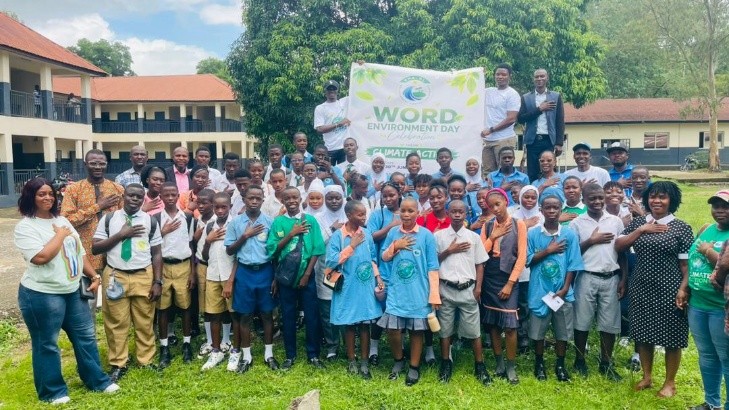
The Environmental Protection Agency Sierra Leone (EPA-SL) commemorated World Environment Day on Tuesday, 30 June 2026, with an interactive youth dialogue on climate action held at the Sleek Office, Fatima Campus of the University of Makeni (UNIMAK).
The event, themed “Climate Action,” brought together students from the International College of Makeni, SOS Hermann Gmeiner School, St. Joseph’s Convent Secondary School, Benevolent Islamic Secondary School, and St. Francis Secondary School, alongside teachers, environmental advocates, and other stakeholders to discuss practical solutions to environmental challenges.
Following opening remarks on environmental sustainability, participants engaged in a lively fireside discussion moderated by EPA North-East Region Public Relations Officer Charles Lebbie Jr. and University of Makeni student Demba M. Kamara. The session encouraged students to share their perspectives on climate change and the role young people can play in protecting the environment.
Fatima Khadija Unisa Sesay of the International College of Makeni described climate change as a growing global challenge driven by human activities such as deforestation, pollution, and indiscriminate waste disposal. She urged young people to become environmental ambassadors by promoting awareness and adopting sustainable practices.
Students from SOS Hermann Gmeiner School, Ishmael Kandeh and Baba Janneh, noted that rising temperatures, erratic rainfall, and declining agricultural productivity are clear signs of climate change. They called for increased tree planting, improved waste management, and stronger community participation in forest conservation.
Representing St. Joseph’s Convent Secondary School, Sonia Onikeh Sannoh emphasized the importance of integrating environmental education into school activities, describing it as a vital step toward building climate resilience among young people.
Hawanatu Kamara of Benevolent Islamic Secondary School identified poor sanitation, indiscriminate waste disposal, and plastic pollution as major environmental concerns affecting communities. She encouraged citizens to adopt proper waste management practices and actively participate in community clean-up campaigns.
Alpha Bi Kamara of St. Francis Secondary School advocated for greater investment in renewable energy, environmental conservation, and stricter enforcement of environmental regulations to protect Sierra Leone’s natural resources.
During the discussion, students highlighted pollution, bush burning, deforestation, and poor waste management as key drivers of climate change. They proposed practical solutions, including tree planting, recycling, environmental awareness campaigns, reducing plastic use, strengthening environmental laws, and expanding renewable energy initiatives.
Closing the dialogue, moderator Demba M. Kamara commended the students for their insightful contributions and encouraged them to turn their ideas into meaningful actions within their schools and communities. Charles Lebbie Jr. reminded participants that addressing climate change requires the collective commitment of government, institutions, communities, and individuals.
The programme concluded with closing remarks, a vote of thanks, a group photograph, and a symbolic tree-planting exercise, reinforcing participants’ commitment to environmental conservation and sustainable development.