



By Mackie M. Jalloh
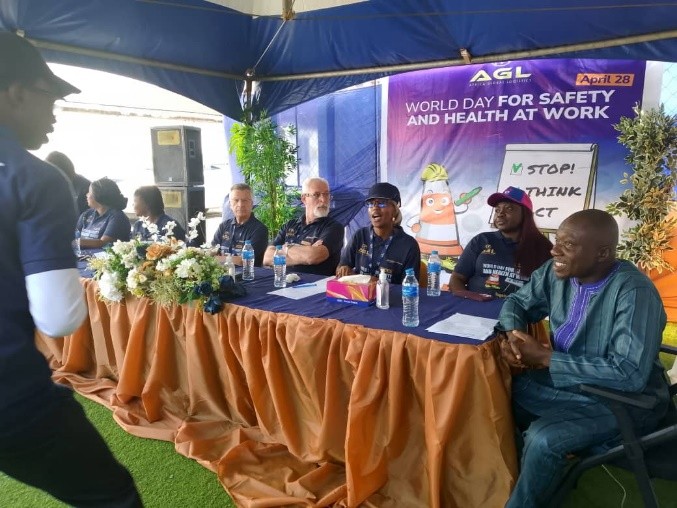
At a time when workplace accidents continue to pose serious risks across industries, Africa Global Logistics (AGL) used this year’s World Day for Safety and Health at Work to send a clear and uncompromising message: safety is not optional it is operationally essential. Marking the global observance on April 28, 2026, the company transformed its Cline Town, Water Quay facility in Freetown into a hub of reflection, demonstration, and institutional accountability.
Rather than treating the day as a routine commemoration, AGL positioned the event as a strategic intervention aimed at reshaping workplace attitudes. Under the theme “Stop, Think and Act,” the gathering brought together company leadership, safety experts, workers, and members of the media to interrogate the realities of occupational hazards and the persistent gaps in compliance and awareness.
What emerged from the discussions was a firm rejection of the common tendency to normalize workplace accidents. According to AGL’s management, incidents are rarely inevitable; instead, they are often the result of systemic negligence, weak enforcement of protocols, or complacency among workers and supervisors.
Delivering a technical presentation, AGL Manager Maroun Abia Aad challenged the notion that lack of knowledge is the primary cause of workplace injuries. He argued that, in many cases, employees are aware of safety procedures but fail to apply them consistently. This, he noted, points to a deeper institutional issue one that requires not only training but a shift in organizational culture.
He emphasized that continuous education, reinforced supervision, and strict adherence to established safety frameworks must become embedded in daily operations. Without these, even the most sophisticated safety policies remain ineffective. His remarks underscored a critical point: safety systems are only as strong as the behavior of those expected to implement them.
AGL’s Regional Managing Director, Captain Fabjanka Kokan, took a more direct tone, framing safety as a matter of life and death rather than compliance. In a stark reminder to workers, he noted that financial gain should never come at the expense of personal safety. His message was unambiguous returning home alive outweighs any economic benefit derived from unsafe practices.
He further stressed that safety is not merely a regulatory requirement but a mindset that must be internalized at every level of the organization. From senior management to frontline workers, accountability must be shared and enforced without compromise.
Expanding the conversation beyond conventional safety concerns, Mr. Aiah Mokuwah of IDCHS introduced a critical but often overlooked dimension: substance abuse in the workplace. His keynote address drew attention to the direct link between drug use and increased risk of accidents, impaired judgment, and reduced productivity.
He warned that organizations that fail to address substance abuse risk undermining not only their safety standards but also their overall operational efficiency. In high-risk environments such as logistics and port operations, even minor lapses in judgment can have catastrophic consequences. His intervention added a layer of urgency to the broader safety discourse, highlighting the need for comprehensive workplace policies that address both physical and behavioral risks.
Beyond speeches, the event was anchored by practical demonstrations from AGL’s operational units. Eight departments including Technical, Operations, Ship/Yard Operations, Quality Health Safety and Environment (QHSE), Protec Security, Documentation, AGL/SALS, and Administration participated in a structured exhibition designed to translate safety theory into practice.
Each department showcased real-world scenarios, risk mitigation strategies, and compliance procedures relevant to their functions. These demonstrations served not only as internal learning tools but also as a public display of AGL’s safety infrastructure and operational discipline.
The competitive element of the exhibition added an extra layer of engagement, encouraging departments to critically assess and improve their safety protocols. At the conclusion of the exercise, the Administration Department emerged as the overall winner, reflecting its strong adherence to safety standards across multiple operational areas.
The event concluded with a vote of thanks delivered by Patrick Jarbee, who acknowledged the collective effort required to sustain such an initiative. He commended staff participation and reiterated the importance of maintaining momentum beyond the symbolic observance.
In reframing World Day for Safety and Health at Work as more than a ceremonial event, AGL has signaled a shift toward proactive risk management and institutional accountability. The company’s approach reflects a growing recognition that safety cannot be treated as a periodic concern it must be a continuous, enforced, and measurable priority embedded within organizational culture.
As industries across Sierra Leone grapple with evolving safety challenges, AGL’s intervention serves as both a model and a warning: without deliberate action, awareness alone is insufficient.