



By Sahrfoa Matturie
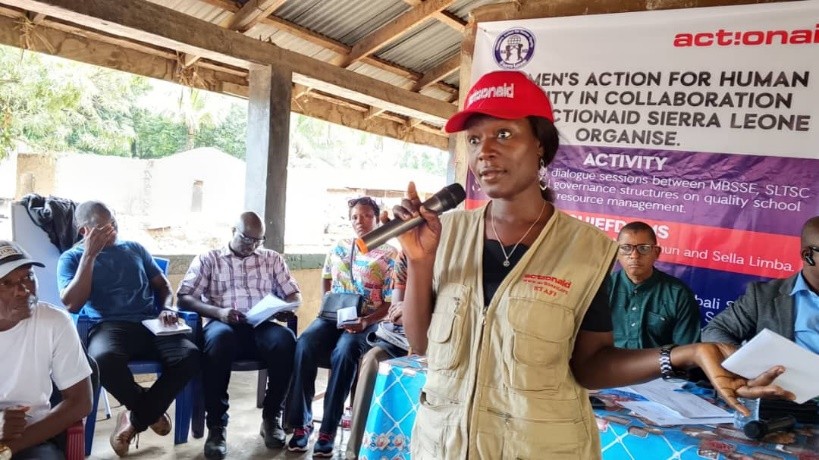
Women’s Action for Human Dignity (WAHD), with support from ActionAid Sierra Leone, has convened a chiefdom-level dialogue in Manonkoh Community, Bombali Sieray Chiefdom, aimed at improving school resource management and addressing challenges affecting quality education in rural communities.
The engagement brought together representatives from local councils, the Ministry of Basic and Senior Secondary School Education (MBSSE), the Sierra Leone Teaching Service Commission (SLTSC), school management structures, community leaders, teachers, parents, and other education stakeholders to discuss barriers to effective learning and identify practical solutions.
Speaking on behalf of ActionAid Sierra Leone’s Regional Manager, Michaella Sallu reaffirmed the organization’s commitment to supporting education through sponsorship programmes and community-based interventions.
She noted that education remains a key priority for ActionAid, emphasizing the need to understand why some children are not attending or remaining in school.
“We want to identify existing gaps and understand the challenges affecting children’s education. Open discussions like this will help us find solutions and improve educational outcomes in our communities,” she said.
Sallu encouraged participants to speak freely, explaining that the concerns and recommendations raised would feed into the Participatory Review and Reflection Process (PRRP), helping inform future planning and budgeting.
Welcoming participants, WAHD-SL Director Haja Betty Alimamy Sesay thanked ActionAid Sierra Leone for supporting the initiative and reiterated WAHD’s commitment to promoting quality education and community participation.
She described the dialogue as an important opportunity for communities to engage directly with education authorities and discuss issues affecting schools and children’s learning.
One of the major concerns raised during the dialogue was the shortage of approved teachers in schools across the chiefdom. Chairperson of the School Management Committee of WCSL Primary School, Rokonta, Mammy Fatu Sesay, appealed to government and the Teaching Service Commission to approve more teachers.
She explained that many schools currently depend on community teachers to maintain classroom activities, stressing that the shortage of qualified teachers continues to affect the quality of education.
Responding to concerns, Deputy District Officer of the Sierra Leone Teaching Service Commission, Chernor Amid Jalloh, acknowledged the challenges facing the sector and assured participants that their concerns would be considered.
He disclosed that government has approved the recruitment of 2,000 teachers nationwide, while additional recruitment backlogs have increased the total number of teachers under consideration to approximately 4,000.
Jalloh, however, emphasized that all prospective teachers must meet professional requirements established by the Commission. He explained that teaching is now regulated to ensure only qualified individuals enter the profession.
According to him, teachers must possess recognized qualifications such as a Teachers Certificate (TC), Higher Teachers Certificate (HTC), Bachelor of Education (B.Ed.), or Bachelor of Arts in Education. He further noted that graduates from other disciplines must obtain postgraduate qualifications in education before they can be employed as teachers.
He also highlighted the importance of registration with the Teaching Service Commission and certification through the National Council for Technical, Vocational and Other Academic Awards (NCTVA).
Jalloh expressed concern over recent findings showing that many pupils struggle with reading and writing. He revealed that government has introduced literacy programmes targeting pupils in lower primary classes to improve foundational learning skills.
Also addressing the gathering, School Quality Assurance Officer of MBSSE, Alisious Bangali, reaffirmed the ministry’s commitment to ensuring accountability and proper management of school resources.
Participants raised concerns relating to teacher shortages, school governance, delayed subsidy payments, inadequate resource allocation, and the overall quality of education in their communities.
The dialogue concluded with calls for stronger collaboration among government institutions, development partners, school authorities, parents, and community leaders to address educational challenges. Stakeholders expressed optimism that recommendations from the engagement would contribute to policy discussions and improve education service delivery in Bombali District and beyond.
Similar dialogue sessions are expected to be held in Kagbere, Magbaimba N’dorhahun Chiefdom, and Sella Limba Chiefdom in Karene District as part of efforts to strengthen community participation and promote quality education for all children.