



By Marion (Rion) Bangura
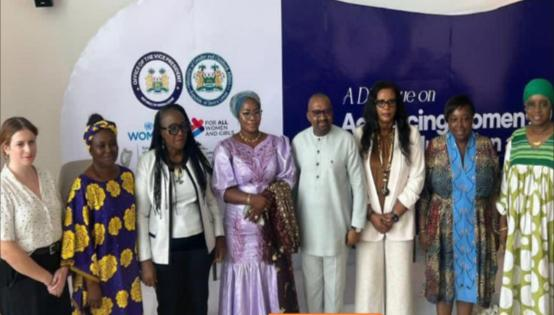
A broad coalition of policymakers, development partners, civil society representatives, and women leaders has begun shaping a national framework aimed at strengthening women’s participation and leadership across Sierra Leone. The engagement, held as part of preparations for the country’s first-ever National Women’s Conference, provided a platform for stakeholders to reflect on the progress made toward gender equality while identifying persistent barriers facing women and girls nationwide.
The national consultation was convened by the Office of the Vice President in partnership with the Ministry of Gender and Children’s Affairs. It brought together voices from across government institutions, civil society organizations, women-led groups, and international partners to help shape priorities that will guide the upcoming conference expected later this year.
Throughout the dialogue, participants focused on issues such as women’s political representation, economic empowerment, access to education and healthcare, and the need to strengthen protections for women and girls. Many contributors emphasized that while Sierra Leone has recorded notable achievements in advancing gender equality, structural and cultural barriers still prevent many women from fully participating in leadership and decision-making processes.
Opening the consultation, the Minister of Gender and Children’s Affairs highlighted the importance of engaging a wide range of stakeholders in designing the agenda for the forthcoming conference. She noted that the national gathering is intended to go beyond symbolic discussions by generating practical solutions to the challenges confronting women across urban and rural communities.
According to the minister, the dialogue offered an opportunity for women leaders, activists, and policymakers to openly discuss concerns affecting their communities while contributing ideas that will influence national policy directions.
Delivering the keynote address, Vice President Mohamed Juldeh Jalloh emphasized that meaningful progress in gender equality requires sustained political commitment and deliberate action. He commended the ministry for initiating the consultation process and stressed that the government remains determined to strengthen opportunities for women at every level of society.
The Vice President pointed to the implementation of the Gender Equality and Women’s Empowerment Act as one of the country’s major milestones in promoting women’s representation in governance. Under the legislation, a minimum quota for women’s participation in political and public institutions has been established, a move widely seen as a step toward correcting long-standing gender imbalances.
However, he cautioned that representation alone is not sufficient. According to him, efforts must also focus on ensuring that women who enter leadership spaces are empowered with the resources, influence, and institutional support necessary to shape policy and drive development.
He also highlighted the significant role women play in Sierra Leone’s economic life, particularly in agriculture, small-scale trade, and community development initiatives. Despite these contributions, he acknowledged that many women continue to face limitations in accessing finance, education, and healthcare.
As part of ongoing efforts to address these gaps, the Vice President referenced the government’s “300 Days Campaign,” a national initiative designed to reduce preventable maternal and child deaths through improved healthcare services and targeted interventions for women and families.
In addition, he revealed that discussions are advancing toward the establishment of Kombra Bank, which is envisioned as the country’s first financial institution specifically designed to support women’s economic advancement. The proposed bank is expected to provide tailored financial services to women entrepreneurs and small business owners, with investment backing from partners including Vista Bank Group.
Organizers say the national consultation marks an important step in the lead-up to the National Women’s Conference, which will bring together participants from across the country to evaluate progress, share experiences, and develop strategies to advance gender equality.
Participants at the dialogue expressed optimism that the conference will serve as a turning point in strengthening women’s voices in national development. Many stressed that the event should produce clear policy commitments and measurable actions that will improve opportunities for women and girls throughout Sierra Leone.
As planning continues, stakeholders say the ultimate goal is to ensure that the conference becomes more than a ceremonial gathering, but rather a catalyst for meaningful and lasting change in the lives of Sierra Leonean women.