



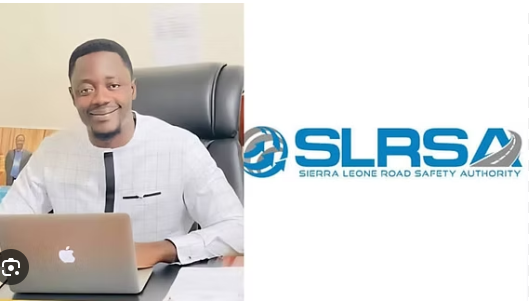
By Mackie M. Jalloh
The Sierra Leone Road Safety Authority (SLRSA) is undergoing one of the most far-reaching administrative and technological restructurings in its history, following a new reform agenda spearheaded by its Executive Director, James Bagie Bio. The changes signal a decisive institutional pivot toward automation, decentralization, fiscal transparency, and compliance-driven road governance.
At the core of the transformation is a structural shift in how core services are delivered. For decades, driver’s license and vehicle registration processes were heavily centralized in Freetown, creating systemic bottlenecks, long processing times, and unnecessary travel burdens for citizens in provincial districts. Under the current reforms, license production and related documentation services are being decentralized to regional centers. The objective is operational efficiency: reducing turnaround time, decongesting the capital, and improving citizen access to essential regulatory services.
In parallel with decentralization, the Authority has piloted a Radio Frequency Identification (RFID) vehicle tracking and verification system—an intervention designed to modernize roadside enforcement. The handheld scanning device enables officers to retrieve, in real time, a vehicle’s registration status, ownership profile, license validity, color specification, and other identification markers within seconds. The system reduces manual verification errors, curbs document forgery, and enhances data integrity across enforcement operations. By digitizing roadside checks, SLRSA is transitioning from reactive policing to data-driven compliance management.
Financial reforms have also been introduced through the deployment of Point of Sale (POS) payment platforms at operational centers. Motorists can now process payments via mobile money services and banking channels, minimizing cash transactions. This measure strengthens audit trails, reduces revenue leakages, and aligns the Authority’s financial procedures with contemporary public sector accountability standards.
Additionally, SLRSA has established a standardized vehicle fitness and inspection center equipped to conduct structured road-worthiness assessments. The facility is designed to apply uniform testing protocols for private vehicles, commercial fleets, and heavy-duty machinery. This represents a shift from fragmented inspection practices toward systematic, technology-supported evaluation aimed at reducing mechanical-related road accidents.
Beyond infrastructure upgrades, the reform agenda has introduced procedural streamlining and performance-oriented management practices. Internal workflows have reportedly been digitized, documentation timelines shortened, and compliance monitoring strengthened. Collectively, these measures reflect a broader institutional recalibration. Rather than operating solely as a licensing body, SLRSA is positioning itself as a technologically enabled regulatory authority focused on service delivery efficiency, enforcement precision, and public safety outcomes