



By Mackie M. Jalloh
In the decaying heart of Freetown — from the swampy shacks of Kroo Bay to the rusted outskirts of Kissy— a slow and deadly war is unfolding. It is not a war of politics or religion, but of addiction and despair. Its weapon is a synthetic drug known as Kush, and its casualties are Sierra Leone’s young men and women, reduced to hollow shells of who they once were.
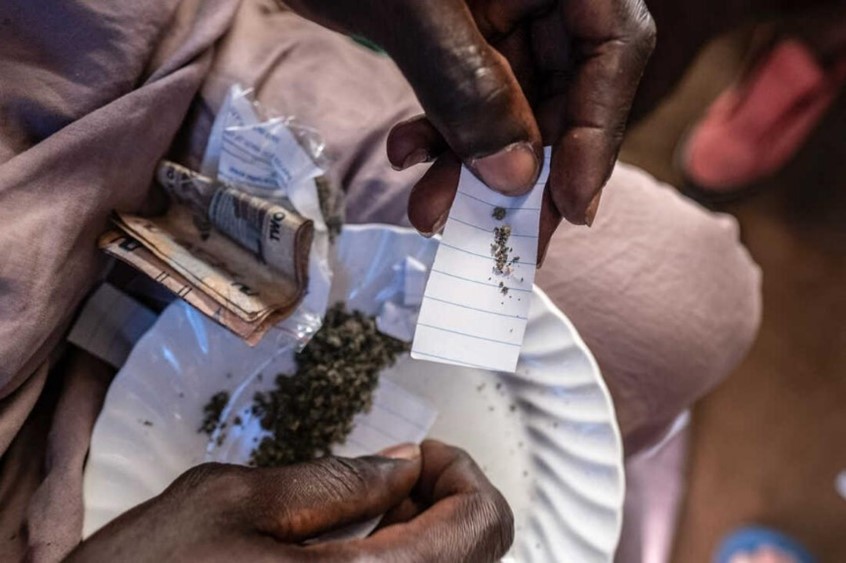
Kush looks like marijuana but is far deadlier. Experts say it can be 25 times stronger than fentanyl, a potency that has earned it the nickname “the zombie drug.” Across Sierra Leone, this synthetic poison is creating an underworld in plain sight — turning classrooms, markets, and alleyways into open drug dens.
“I keep smoking it because it makes me forget about my worries and challenges,” says Memunatu, a 24-year-old woman from Kroo Bay, heavily pregnant with her second child. “It’s a temporary escape… but with a brutal come down.” Her eyes are sunken, her hands tremble, and her voice carries the weight of hopelessness. She wants to quit but cannot. “As long as I’m here, I’ll keep smoking it,” she admits.
The den where Memunatu lives is a haunting picture of decay — thin mats, rotten boards, and the stench of infection. Around her, teenagers and adults lie motionless, some with open sores that refuse to heal. Saidu, barely 17, pulls up his trousers to reveal gaping wounds on his legs. “Look at me,” he says softly. “Just because of this drug, I have sores on my feet. This drug brings destruction.”
A few meters away, 14-year-old Kadiatu sits in a corner, her legs twisted and swollen. She started smoking Kush at 12. Now, she cannot walk. “They have to wash her wounds every day,” says a local volunteer. “She cries when they clean it, but when the pain eases, she asks for more Kush.”
These are not the fringes of society — they are its broken center. In Freetown’s Kroo Bay, drug dens have appeared under bridges and behind schools. In Kissy, addicts live beneath the same roads that carry government convoys to and from various offices. Their cries for help echo beneath the city’s noise. “All we are saying is, we need help,” one man pleads. “Look at our condition. We are dying slowly.”
Yet despite the visible decay, the government of Sierra Leone remains largely silent. While officials issue press releases and hold “stakeholder dialogues,” little is being done to confront the reality on the ground. There are no functioning rehabilitation centers, no sustained education campaigns, and no serious crackdown on those who import, produce, or distribute the drug.
Behind the silence lies suspicion. Investigations and whispers among local residents suggest that some individuals with political or business ties may be profiting from the Kush trade. Reports of hidden Kush farms, particularly in the northern provinces, have circulated for years, yet few arrests have been made. The alleged complicity of powerful figures — those who shield traffickers and manufacturers — has turned the epidemic into a national scandal shrouded in impunity.
“How can this drug enter every community in Freetown, every town upcountry, and the government say they don’t know who is behind it?” asks a youth activist from Kissy. “Someone is protecting them. Someone is benefiting while our young people die.”
The cost is staggering. Hospitals are overwhelmed with psychotic patients. Families are collapsing. Children are being born into addiction. Sierra Leone, already struggling with poverty and unemployment, now faces a generational catastrophe — one that threatens to undo decades of progress.
Health experts warn that the Kush crisis is no longer just a drug problem, but a humanitarian one. “This is a social collapse happening in slow motion,” says one social worker who has been documenting the epidemic. “We are raising a generation of the walking dead — enslaved not by choice, but by neglect.”
And in the shadows of the city, the cycle continues. Addicts sell scraps, beg for coins, or steal to buy their next smoke. Some die quietly; others vanish. Their bodies are often buried anonymously, their stories untold.
Kush has become a mirror reflecting Sierra Leone’s greatest failure — the failure to protect its youth. Until the government acts decisively, until those who profit from this trade are exposed and punished, the epidemic will continue to rot the country from within.
For now, the cries from Kroo Bay and Kissy remain unanswered — a chilling reminder that Sierra Leone’s future is being burned away, joint by joint, in the cold ashes of Kush.