



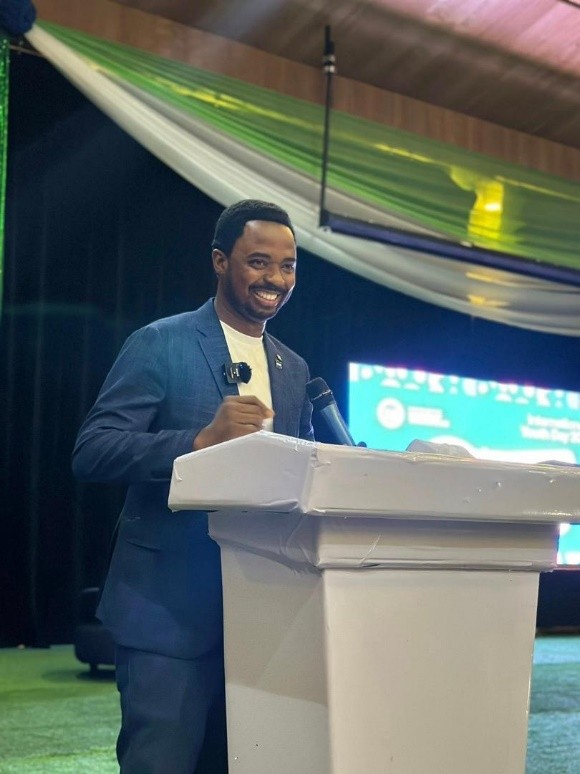
By Mahamood Fofana
The Minister of Youth Affairs, Ibrahim Sannoh, has outlined a new strategic direction aimed at expanding opportunities for young people across Sierra Leone, pledging that government programs will be structured to ensure inclusion for youths from all backgrounds, including those in marginalized communities.
Speaking during an engagement with the media, the minister explained that the Ministry of Youth Affairs is prioritising four major thematic areas designed to tackle youth unemployment and promote long-term economic participation. These focus areas include agriculture, climate action, skills development, and technology and innovation.
According to Sannoh, the approach reflects the government’s determination to harness the potential of Sierra Leone’s youthful population while addressing structural barriers that have limited opportunities for many young people.
Agriculture, he said, remains a key pillar of the ministry’s strategy, particularly in support of the government’s national food security agenda under the Feed Salone Initiative. The minister noted that young people are being encouraged to view agriculture not simply as subsistence farming but as a modern and profitable business sector.
He emphasized that commercial farming, agribusiness, and value chain development present enormous opportunities for youth employment while also strengthening the country’s food production capacity.
Beyond agriculture, the ministry is placing strong emphasis on technical and vocational training as a pathway for youth empowerment. Sannoh explained that equipping young people with practical and industry-relevant skills is essential to enabling them to compete in an increasingly demanding labor market.
He highlighted traditional trades such as carpentry, electrical installation, and automobile mechanics as areas where training programs are being expanded. The ministry, he revealed, is also engaging with private sector partners, including Leone Rock Metal Group, to better understand workforce demands within the mining industry.
As part of these efforts, discussions are underway with Ernest Bai Koroma University of Science and Technology in Makeni to develop specialised training opportunities for young people that align with the technical needs of the mining and industrial sectors.
The minister further disclosed that a similar skills initiative is already in progress at Milton Margai Technical University, where commercial motorcycle riders are receiving intensive technical training designed to help them transition into more stable and sustainable forms of employment. Participants who complete the program are also provided with start-up kits to help them begin new trades.
Gender inclusion also features prominently in the ministry’s youth development strategy. With support from the United Nations Development Program (UNDP), approximately 280 women recently graduated from training programs at the Armed Forces Technical Education College in Freetown. The women received instruction in technical fields traditionally dominated by men, opening new economic opportunities for female participation in vocational industries.
Sannoh said the initiative demonstrates the government’s commitment to ensuring that young women benefit equally from technical and professional training programmes.
In addition, the minister stressed the importance of preparing young people for the digital economy. He noted that technology and innovation will play a critical role in future job creation, and the ministry is exploring programs aimed at strengthening digital skills, entrepreneurship, and innovation among Sierra Leonean youth.
According to Sannoh, the overall objective of the ministry’s strategy is to ensure that every young person feels included in national development and has access to opportunities that allow them to build sustainable livelihoods. He maintained that by focusing on agriculture, skills development, gender inclusion, and technology, the government hopes to empower a generation capable of driving economic growth and social transformation in Sierra Leone