



By Mackie M. Jalloh
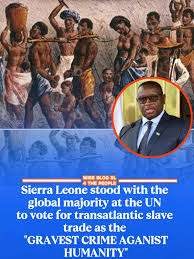
Sierra Leone has taken a firm diplomatic stance on the global stage, aligning itself with a coalition of African and Caribbean nations in support of a United Nations General Assembly resolution that elevates the transatlantic slave trade to what proponents describe as the most egregious crime in human history. The move signals not only a symbolic gesture of remembrance, but also a calculated positioning within an intensifying international discourse around historical accountability and reparatory justice.
The resolution, which was tabled by Ghana and backed by the African Union alongside several Caribbean states, sought to reframe the historical narrative of slavery within international law and moral consciousness. When the vote was called at the United Nations General Assembly, 123 countries voted in favor, reflecting a strong majority. However, the fractures in global consensus were equally visible, with notable opposition from United States, Israel, and Argentina, while key Western powers, including United Kingdom and member states of the European Union, refrained from endorsing the motion through abstention.
For Sierra Leone, the decision to vote in favor cannot be detached from its historical and sociopolitical context. The country occupies a unique place in the history of the transatlantic slave trade not only as a site from which countless Africans were forcibly taken, but also as a settlement for freed slaves returning from the Americas and Britain. This dual legacy has embedded the memory of slavery deeply within its national consciousness, making its support for the resolution both a moral imperative and a reflection of historical continuity.
Diplomatic observers interpret Sierra Leone’s vote as part of a broader African strategy aimed at reshaping global narratives around slavery and colonialism. By reinforcing the classification of the slave trade as an unparalleled crime against humanity, African states are increasingly pushing for recognition that goes beyond symbolic acknowledgment. The underlying objective is to create a stronger legal and ethical foundation for future claims related to reparations, restitution, and systemic redress.
The political messaging surrounding the resolution was equally significant. Ghana’s Foreign Minister, Samuel Okudzeto Ablakwa, publicly celebrated the outcome, framing it as a collective victory for people of African descent worldwide. Meanwhile, President John Dramani Mahama, speaking in his capacity as a representative voice within the African bloc, emphasized the necessity of institutional memory. He argued that formal recognition at the UN level serves as a safeguard against historical erasure and denial, particularly at a time when global conversations on race and inequality remain deeply polarized.
The transatlantic slave trade, spanning roughly four centuries, resulted in the forced displacement of millions of Africans under conditions widely documented as inhumane and brutal. Historians estimate that over 12 million individuals were transported across the Atlantic, with mortality rates during the Middle Passage underscoring the sheer scale of human suffering involved. For countries like Sierra Leone, these statistics are not abstract figures but lived histories that continue to influence contemporary social and economic realities.
Despite the overwhelming support for the resolution, its non-binding nature limits its immediate legal consequences. However, its significance lies in agenda-setting. It provides political momentum for advocacy groups, scholars, and governments seeking to advance discussions on reparative justice. It also intensifies scrutiny on nations that have historically benefited from the slave trade but remain reluctant to engage in substantive reparations dialogue.
Critically, the voting pattern exposes enduring geopolitical tensions. The abstention of European nations and the outright opposition from others suggest a reluctance to endorse language that could potentially translate into financial or legal obligations. This hesitancy reflects broader concerns about precedent setting within international law and the potential implications for former colonial powers.
For Sierra Leone, however, the calculus appears less ambiguous. The vote represents a reaffirmation of its alignment with continental priorities and a strategic assertion of its historical narrative within global forums. It underscores a willingness to participate actively in shaping international discourse on justice, memory, and accountability.
As the global community grapples with the legacies of slavery and colonialism, Sierra Leone’s position illustrates how historical experience continues to inform present day diplomacy. The resolution may not impose immediate change, but it undeniably shifts the moral terrain one where nations like Sierra Leone are insisting that the past must not only be remembered but reckoned with in tangible ways.