



By Bankole Labode Oyou
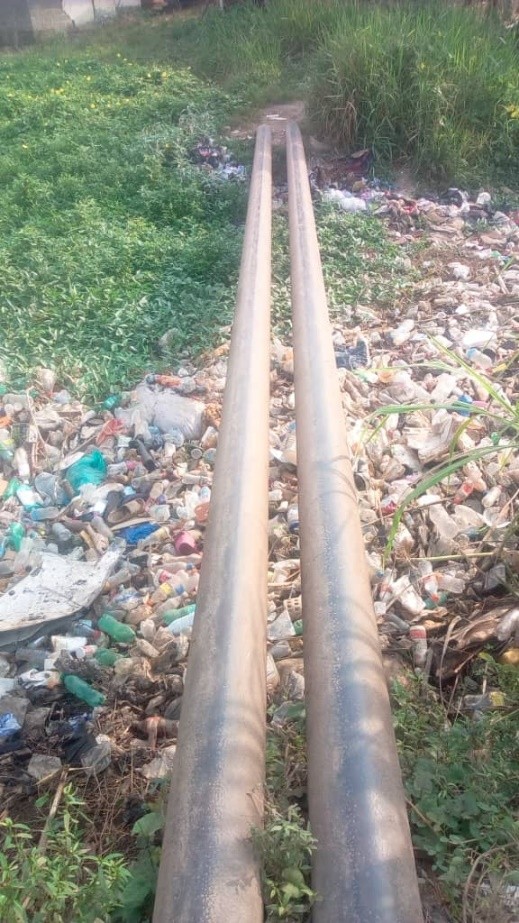
Residents of the Bongo Town community in Makeni have expressed growing outrage and concern over the deplorable condition of a footbridge they describe as a “death trap,” calling on relevant authorities to take urgent action before lives are lost.
Bongo Town is located along the Ropolon, MCA, and Ernest Bai Koroma University axis in Makeni, northeastern Sierra Leone. The community is largely agrarian, with most residents engaged in small-scale farming as their primary source of livelihood. Despite its strategic location and proximity to key institutions, the area is burdened by poor infrastructure, with the footbridge standing out as a major safety hazard.
The bridge, which consists of narrow metal poles loosely arranged to serve as a crossing, connects thousands of people daily. It links Bongo Town to surrounding areas including Benevolent Secondary School, Thoronka Street, and other neighboring communities. For residents, pupils, traders, and university students, the bridge is not optional but a necessary route for daily movement.
According to first-hand accounts, crossing the bridge is a frightening experience that requires extreme caution. Residents say pedestrians are forced to balance carefully on exposed metal poles, stretching their legs to avoid falling through wide gaps. A single misstep, they warn, could result in serious injury or death.
Community elder Andrew A. Turay told this reporter that although the bridge plays a critical role in connecting important institutions and communities, it has become a constant source of fear and frustration. “Movement across this bridge is extremely challenging. Access to nearby schools, the university, and other communities would be much easier if authorities paid serious attention to this structure we are forced to call a bridge,” he said. Turay added that residents remain determined to continue pressing their leaders until action is taken.
Mabinty Kamara, Chairlady of the MCA community, highlighted the impact of the situation on children and students. She explained that the bridge is the shortest and most convenient route for school pupils and university students, but instead of easing their journey, it exposes them to daily danger. “Every day I watch children struggle to cross this bridge. During the rainy season, the situation becomes worse. Sometimes the water rises above ankle level, forcing pupils and students to remove their shoes to cross,” she said, appealing for a sustainable solution.
The councillor representing the affected area, Councillor Loveta I. Turay, confirmed in a phone interview that she is fully aware of the community’s plight. She stated that she has consistently raised the issue at council level and pledged to intensify her advocacy now that the matter has gained media attention. “I am even more determined to pursue this until something meaningful is done,” she vowed.
Responding to the concerns, Edward Kpukumu, Information, Education and Communication Officer at the Makeni City Council, acknowledged that the council is aware of the situation. He said the issue has been raised in previous council meetings and that any proposed intervention would require technical input from council engineers. However, he noted that progress largely depends on funding from central government. For now, residents of Bongo Town continue to endure the daily risk of crossing the bridge, hoping that their calls for urgent intervention will finally translate into concrete action.