



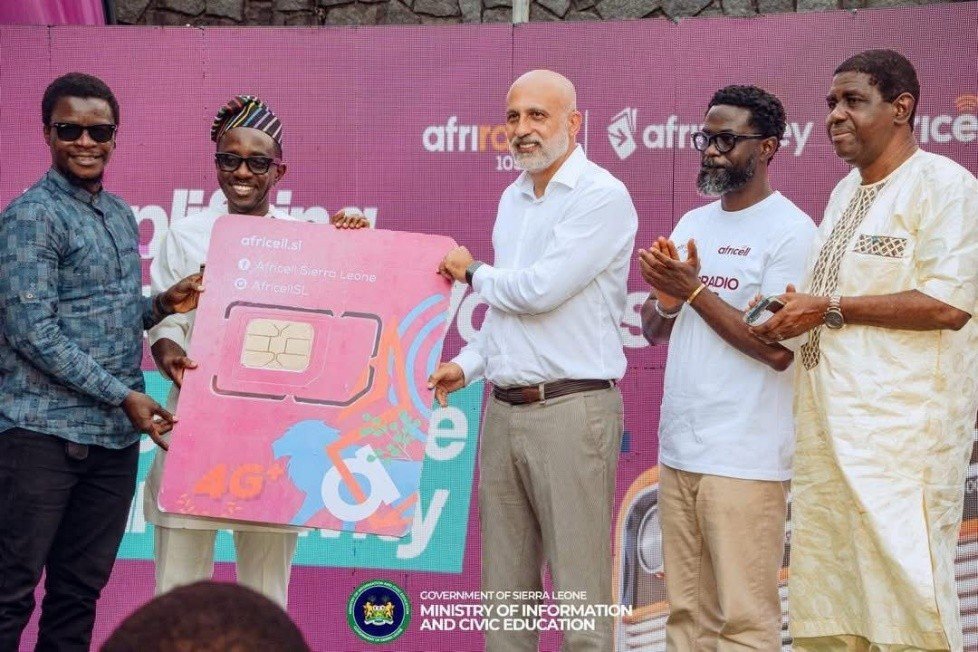
In a move poised to recalibrate public discourse and civic participation across Sierra Leone, Africell Sierra Leone has launched a nationwide free call-in service for radio stations, eliminating cost barriers that have historically restricted citizen engagement in broadcast conversations.
The initiative, unveiled on Friday, 13 February 2026, at Africell’s headquarters in Wilberforce, Freetown, forms part of activities marking World Radio Day. At its core, the intervention is designed to democratize access to the airwaves by allowing Africell subscribers to participate in designated radio programs at no charge. For a country where radio remains the most pervasive and trusted medium of information, the implications are significant.
Speaking during the launch, Africell’s Media Relations Manager, Abdul Karim Sesay, framed the service as a structural response to longstanding communication inequities. He observed that many Sierra Leoneans, particularly those in low-income and rural communities, are often unable to afford airtime to contribute to discussions on governance, public health, or national security. As a result, critical community-level perspectives remain excluded from national dialogue.
According to Sesay, access to public conversation should not hinge on purchasing power. By removing financial constraints, Africell intends to widen participation, strengthen information flow, and enhance accountability. He further disclosed that the company currently supports media institutions across all 16 districts through connectivity services, 24-hour electricity provision, and direct financial assistance—interventions he said are delivered without editorial interference, preserving media independence while reinforcing operational sustainability.
Representing radio managers, Brigitte Dalton-Sesay, General Manager of Radio Fry Fry, described radio as a unifying platform that bridges geographic and socio-economic divides. She noted that Africell has maintained partnerships with media houses for over two decades and now collaborates with more than 110 outlets nationwide. These partnerships encompass infrastructure support, tower access, energy solutions, and secure technological services.
Dalton-Sesay underscored that electricity constitutes one of the most significant operational expenditures for radio stations. In that context, Africell’s energy interventions and connectivity support have been instrumental in maintaining uninterrupted broadcasts. She characterized the free call-in service as a transformative enhancement, enabling stations to deepen listener engagement and fulfill their public-service mandate more effectively.
From a disaster management perspective, John Vandy Rogers, General Manager of the National Disaster Management Agency (NDMA), emphasized radio’s indispensable role in early warning and crisis response systems. He pointed to the nationwide toll-free hotline 1199, developed in partnership with Africell, which facilitates real-time hazard reporting. Removing communication costs, he argued, will strengthen community-based surveillance and enable authorities to detect and respond to risks more swiftly—particularly in remote or underserved areas.
Similarly, Francis Langumba Keili, Chief of Staff at the Office of National Security (ONS), contextualized the initiative within Sierra Leone’s people-centred security architecture. He stated that national security is predicated on timely intelligence from citizens and local structures, yet communication costs often deter urgent reporting. By enhancing rapid information transmission from vulnerable communities, the free call-in platform is expected to bolster coordinated responses and mitigate destabilizing threats.
The President of the Sierra Leone Association of Journalists (SLAJ), Alhaji Manika Kamara, described the development as a landmark innovation in democratic participation. He reiterated that radio remains the most accessible and credible information channel in Sierra Leone, particularly in remote communities where digital penetration is limited. The removal of call costs, he argued, will expand the democratic space and enable broader inclusion in national conversations. SLAJ, he added, stands ready to collaborate with Africell and development partners to optimize the initiative’s impact.
Delivering remarks at the ceremony, Africell Sierra Leone CEO Shadi Al-Gerjawi disclosed that the service was initially configured with approximately 40 stations but remains open to all radio institutions nationwide, irrespective of existing affiliations. Africell, he said, will provide the necessary technical architecture—including dedicated ports—to ensure seamless integration and reliability. He stressed that the initiative prioritizes social impact over immediate operational returns, citing its potential to improve education, security coordination, and early warning systems.
Beyond broadcast media, Al-Gerjawi announced complementary support for the print sector through “Africell Super Thursday,” a QR-code-driven promotional campaign aimed at boosting newspaper circulation and advertising engagement.
In his keynote address, the Minister of Information and Civic Education, Chernoh Bah, referenced a 2023 study indicating that approximately half of Sierra Leone’s population relies primarily on radio for credible information. He described the free call-in service as a shift from one-directional broadcasting to an interactive national dialogue platform. However, he cautioned against misuse, urging responsible moderation to prevent misinformation and abuse of the microphone.
The event concluded with the signing of memoranda of understanding between Africell and Kalleone Radio and Radio Tonya in Kenema, committing to 24-hour electricity support for their operations.
Collectively, the initiative represents more than a corporate social responsibility gesture. It signals a strategic convergence of telecommunications, media infrastructure, disaster risk management, and national security. If effectively implemented and responsibly utilized, the free call-in service could significantly deepen civic engagement, fortify early-warning mechanisms, and reinforce radio’s enduring role as the backbone of public communication in Sierra Leone.