



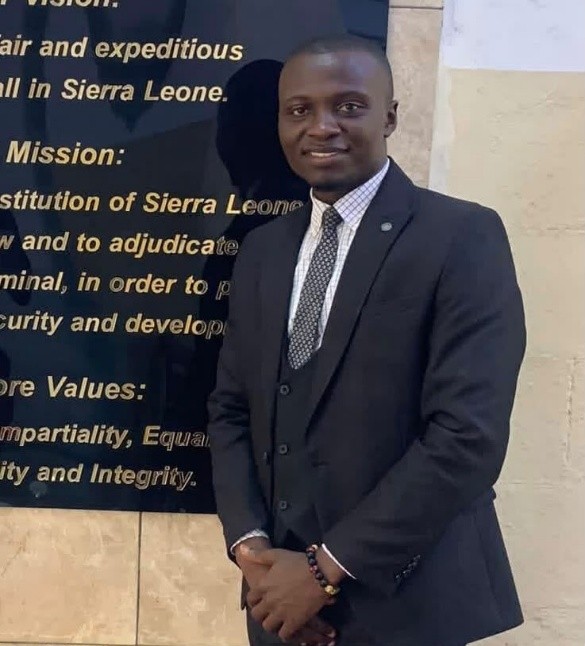
By Mahamood Fofana
Legal practitioner and constitutional expert Paul Kamara Esq. has raised significant constitutional questions over the recent ruling by the Rt. Hon. Speaker of Parliament, Segepoh Solomon Thomas, concerning the meaning of a two-thirds majority required for constitutional amendments.
Kamara argues that the matter should not be treated merely as a political dispute, but as a fundamental question of constitutional interpretation and adherence to the language of Sierra Leone’s 1991 Constitution.
At the centre of his analysis is Section 108(2)(b), which states that a Bill seeking to alter the Constitution shall not be passed unless, at the second and third readings, it is supported by “the votes of not less than two-thirds of the Members of Parliament.”
Kamara contrasts this provision with Section 91(1), which provides that, except where the Constitution states otherwise, questions before Parliament are determined by a majority of the votes of Members “present and voting.”
He argues that the difference in wording between the two provisions is significant.
According to Kamara, Section 91 establishes the general rule for parliamentary voting, while the phrase “Except as otherwise provided in this Constitution” expressly recognises that the Constitution can impose special voting requirements for particular matters.
He therefore maintains that Section 108(2)(b) constitutes such an exception.
In his view, interpreting the two-thirds requirement as applying only to Members present and voting effectively adds words to the Constitution that are not contained in the provision.
“The Constitution knows how to say ‘Members present and voting,’” Kamara argues, pointing out that those words appear expressly in Section 91(1), but not in Section 108(2)(b).
A major part of his argument concerns the distinction between membership and attendance.
Kamara contends that attendance at a parliamentary sitting can fluctuate, whereas membership of Parliament is a constitutional status. Consequently, he argues that the phrase “Members of Parliament” in Section 108(2)(b) should ordinarily refer to the legally recognised membership of the House rather than only those Members physically present during a particular sitting.
He further points to other constitutional provisions that require enhanced parliamentary support, including provisions relating to states of emergency, presidential removal proceedings and the removal of judges.
According to Kamara, these provisions demonstrate a broader constitutional design in which matters of exceptional constitutional importance are protected by higher voting thresholds.
He also refers to Standing Order 44, arguing that Parliament’s own procedural framework distinguishes ordinary decisions requiring a majority of Members “present and voting” from constitutional alteration, for which a two-thirds requirement applies.
While acknowledging that Standing Orders cannot override the Constitution, Kamara says the provision provides useful context for understanding Parliament’s historical treatment of constitutional amendments as fundamentally different from ordinary legislation.
He describes constitutional amendment as a sui generis exercise, arguing that altering the supreme law is fundamentally different from passing ordinary legislation.
In his view, the higher threshold serves as an entrenchment mechanism intended to prevent fundamental constitutional provisions from being altered by a temporary or narrow parliamentary majority.
Kamara also draws on constitutional jurisprudence from other Commonwealth jurisdictions, including Kenya, Uganda and South Africa.
While recognising that decisions from those jurisdictions are persuasive rather than binding on Sierra Leone, he argues that they illustrate a broader constitutional principle: where a constitution deliberately establishes a special threshold for its own alteration, that threshold should be given its full effect.
He also raises concerns about the practical consequences of calculating the two-thirds threshold solely on the basis of Members present and voting.
For example, Kamara suggests that if Parliament had 100 constitutionally recognised Members but only 60 attended a sitting, two-thirds of those present would be 40 Members. Such an interpretation could potentially allow just 40 percent of the total parliamentary membership to approve a constitutional amendment.
For Kamara, this creates the possibility that the constitutional safeguard could become dependent on attendance, meaning that a lower turnout could effectively make constitutional amendment easier.
The central legal question, therefore, is whether the words “two-thirds of the Members of Parliament” in Section 108(2)(b) establish a supermajority requirement based on the entire membership of Parliament, or whether the general rule under Section 91(1) allows the calculation to be based on Members present and voting.
Kamara maintains that the distinction is too important to be reduced to a political contest between parties or between Parliament and its critics.
He also questions whether, after the Speaker determined that the constitutional provision was sufficiently uncertain to warrant reference to the Supreme Court, it would have been institutionally prudent to obtain judicial clarification before proceeding with a potentially irreversible constitutional process.
At the same time, Kamara acknowledges the constitutional responsibility of the Speaker to preside over parliamentary proceedings and determine questions arising before the House.
His concern, he says, is not with the existence of the Speaker’s authority, but with ensuring that parliamentary authority remains subject to constitutional supremacy.
Ultimately, Kamara argues that neither parliamentary practice nor a ruling from the Chair should reduce or dilute a threshold expressly prescribed by the Constitution.
The controversy therefore extends beyond the immediate parliamentary vote. It raises a broader constitutional question about which denominator should be used when calculating the two-thirds requirement.
The interpretation eventually adopted could establish an important precedent for future constitutional amendments and shape the relationship between Parliament, the Speaker and the Supreme Court in interpreting Sierra Leone’s supreme law.
Kamara’s position is that where the Constitution deliberately establishes a higher threshold for altering itself, that safeguard should neither be diluted nor made dependent on the number of Members who happen to attend a particular sitting.
The final authoritative interpretation could ultimately rest with the Supreme Court, whose decision would provide guidance on the meaning and application of Section 108(2)(b).
At stake, therefore, is not merely the outcome of one parliamentary vote, but a fundamental constitutional question: when the Constitution requires two-thirds of the Members of Parliament, does that mean two-thirds of the entire membership or two-thirds of those present and voting?