



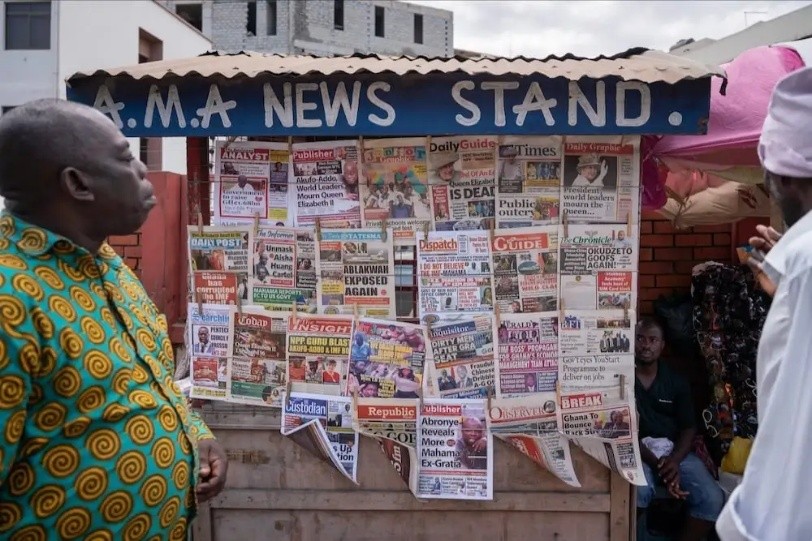
Sierra Leone’s newspaper industry is facing an unprecedented challenge as changing media habits push readers away from printed publications and towards social media platforms for their daily news.
New findings from the Citizen Lens survey by Meraki Analytics suggest that newspapers have lost significant ground in Freetown’s rapidly evolving information ecosystem. The survey, which interviewed 1,217 residents across the capital, found that more than 95 percent of respondents no longer rely on newspapers as a regular source of news.
Instead, digital platforms have become the primary gateway to information for a growing number of Freetown residents. Facebook, TikTok and WhatsApp collectively dominate the news environment, with 54 percent of respondents identifying social media as their main source of news.
By comparison, traditional media—including radio, television and newspapers combined—accounted for just 23 percent of respondents’ primary news sources.
The findings highlight a major shift in how people consume information. News is no longer primarily received through scheduled broadcasts or purchased at newspaper stands. Increasingly, stories are encountered through social media feeds, messaging groups, short videos and content recommended by digital algorithms.
Facebook remains the most widely used platform for news consumption, accounting for 29 percent, while TikTok follows with 15 percent. Radio retains a strong position at 17 percent, but TikTok has already surpassed television as a preferred source of news.
The decline of newspapers is particularly evident among younger audiences. Generation Z and Millennials are overwhelmingly turning to digital platforms, with Facebook and TikTok playing a central role in their news habits. Older audiences, particularly Baby Boomers, continue to show stronger loyalty to radio, but newspapers have struggled to maintain relevance across almost all age groups.
Among those who still read newspapers, Awoko remains the most recognised publication, recording 33 percent of newspaper readership, while Standard Times follows with 23 percent. Awareness Times, Concord Times and Night Watch each attract approximately 12 percent, while Global Times and Salone Times recorded around 2 percent.
However, the report suggests that brand recognition alone may not be enough to guarantee the future of print journalism.
The changing media landscape has created serious financial and professional challenges for newspapers. Advertising revenue is increasingly moving away from local print publications and towards international digital platforms, weakening the traditional business model that has supported newspapers for decades.
At the same time, professionally edited journalism is competing for attention with viral videos, unverified claims, political commentary and user-generated content. The speed and reach of social media often give unverified information an advantage over carefully researched reports.
The shift also raises concerns about the future of public discourse. While newspapers traditionally served as curated platforms where editors and journalists determined which issues deserved public attention, digital algorithms increasingly influence what audiences see and engage with.
Meraki Analytics warns that newspapers must urgently adapt to this new environment. A digital-first strategy, stronger online distribution, engaging multimedia content and greater investment in social media platforms may be essential for the survival of print-based news organisations.
The challenge, however, is not simply to transfer newspaper stories online. Media organisations must also find sustainable ways to finance digital journalism while preserving professional standards, verification and editorial independence.
For decades, newspapers served as an important record of Sierra Leone’s political, social and economic life. They documented national events, scrutinised public officials and provided a platform for civic debate.
Today, that role is being challenged by a new generation of digital consumers who expect news to be immediate, accessible and available on mobile devices.
The future of Sierra Leone’s newspaper industry may therefore depend on whether traditional publishers can successfully transform themselves into modern digital news organisations.
The printed newspaper may not disappear overnight, but the survey results suggest that its dominance has already ended. In Freetown, the battle for the future of journalism is no longer being fought at newspaper stands it is being fought on screens.