



By Sahrfoa Matturie
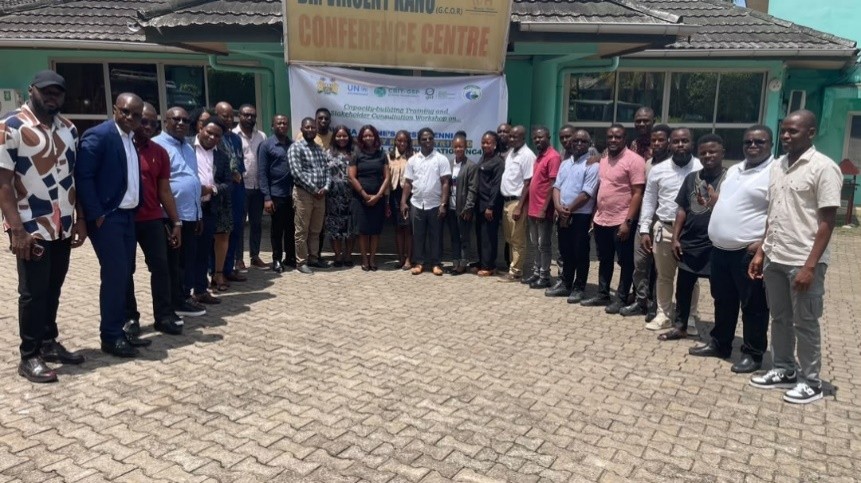
Government officials, environmental experts, development partners, and representatives from key institutions have reaffirmed Sierra Leone’s commitment to strengthening climate transparency and improving environmental reporting during a Capacity-Building Training and Stakeholder Consultation Workshop on the country’s First Biennial Transparency Report (BTR1) and Fourth National Communication (NC4).
The workshop, organized by the Environmental Protection Agency Sierra Leone (EPA-SL) with support from the Global Environment Facility (GEF), the United Nations Environment Programme (UNEP), and the Capacity-Building Initiative for Transparency Global Support Programme (CBIT-GSP), sought to enhance the country’s technical capacity to collect, analyze, and report climate-related data in line with international standards under the Paris Agreement.
The initiative forms part of Sierra Leone’s obligations as a signatory to the Paris Agreement, which requires member states to periodically submit reports detailing greenhouse gas emissions, climate change mitigation efforts, adaptation measures, and progress toward achieving national and global climate commitments.
Bringing together representatives from government ministries, departments and agencies, development partners, academia, and environmental organizations, the workshop provided a platform for strengthening collaboration among institutions responsible for climate data collection and reporting.
Addressing participants, the Staff Director at the Ministry of Agriculture and Food Security, Mr. Andrew Amadu Samura, emphasized that credible climate reporting begins with the availability of accurate and reliable data. He noted that the Biennial Transparency Report serves as a critical scientific instrument for determining Sierra Leone’s contribution to global greenhouse gas emissions and assessing the country’s environmental performance.
According to Mr. Samura, the collection of comprehensive climate data enables experts to measure emissions generated by different sectors of the economy, including agriculture, forestry, energy, transportation, and waste management. Using internationally recognized software and scientific methodologies, specialists can calculate greenhouse gas emissions, analyze national trends, and produce reports that accurately reflect Sierra Leone’s environmental situation.
He explained that such reports are essential not only for fulfilling international obligations but also for informing national policies aimed at promoting sustainable development and climate resilience.
“This report helps us understand whether Sierra Leone is contributing to greenhouse gas emissions that are responsible for global warming. Without accurate data, it becomes impossible to determine our actual emission levels or provide evidence-based information to the international community,” Mr. Samura stated.
He further stressed that robust climate data strengthens decision-making by enabling policymakers to develop effective interventions that support sustainable agriculture, protect natural resources, and reduce environmental degradation. He added that reliable reporting systems also improve the country’s ability to monitor progress in implementing climate action initiatives.
Also speaking at the workshop, the Chief Director of the Environmental Protection Agency Sierra Leone, Mr. Sheku Kanneh, underscored the importance of transparency, accountability, and institutional collaboration in strengthening Sierra Leone’s climate governance framework.
He noted that the preparation of the country’s First Biennial Transparency Report and Fourth National Communication reflects the government’s determination to meet its obligations under international climate agreements while improving national systems for monitoring, reporting, and verifying climate-related information.
Mr. Kanneh highlighted the value of strong partnerships among government institutions, technical experts, development partners, and other stakeholders, explaining that producing comprehensive climate reports requires coordinated efforts across multiple sectors of the economy.
He said high-quality reporting provides policymakers with reliable evidence for designing climate adaptation and mitigation strategies while helping development partners better understand Sierra Leone’s environmental priorities.
Throughout the workshop, participants received technical training on greenhouse gas inventory preparation, internationally accepted methodologies for climate data collection, reporting requirements under the Paris Agreement, and mechanisms for improving institutional coordination in managing climate information.
Interactive sessions also focused on strengthening national systems responsible for data management to ensure that Sierra Leone’s climate reports meet internationally accepted principles of transparency, accuracy, consistency, completeness, and comparability.
Participants exchanged experiences and explored practical approaches to addressing existing challenges, including gaps in data collection, coordination among institutions, and technical capacity needed to support long-term climate reporting.
The Environmental Protection Agency reiterated that producing credible and comprehensive climate reports extends beyond meeting international reporting obligations. The Agency noted that accurate climate data plays a crucial role in positioning Sierra Leone to attract international climate finance, mobilize investment for environmental protection initiatives, and implement evidence-based adaptation and mitigation programmes that benefit vulnerable communities.
Officials further emphasized that transparent reporting enhances the country’s credibility within the global climate community and increases opportunities for technical assistance and financial support aimed at addressing the impacts of climate change.
At the conclusion of the workshop, participants reaffirmed their commitment to strengthening collaboration among institutions responsible for climate reporting and pledged to support the generation of reliable environmental data that will guide national development planning.
The meeting also reinforced the shared understanding that effective climate action depends on sound scientific evidence, coordinated institutional efforts, and sustained investment in national capacity.
With transparency, accountability, and collaboration emerging as the central themes of the engagement, stakeholders agreed that strengthening Sierra Leone’s climate reporting systems will not only fulfill international commitments but also contribute to building a more resilient, environmentally sustainable, and climate-ready nation capable of responding to the growing challenges posed by climate change.