



By Mackie M. Jalloh
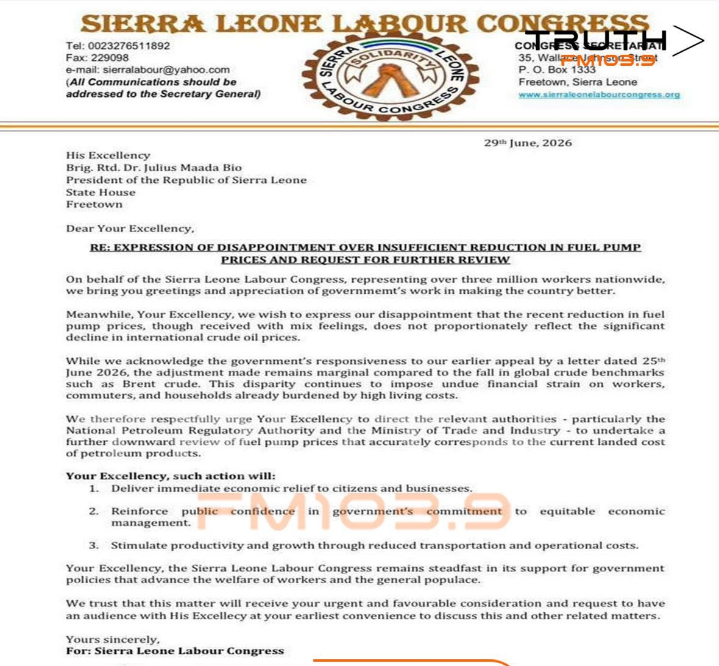
The Sierra Leone Labour Congress (SLLC) has renewed pressure on the Government of Sierra Leone to further reduce the price of fuel, arguing that the latest adjustment at the pumps does not adequately reflect the significant decline in global crude oil prices and therefore offers little relief to struggling citizens.
Representing more than three million workers across the country, the Labour Congress has formally appealed to President Julius Maada Bio to intervene and direct the relevant authorities to undertake another downward review of petroleum pump prices. The union believes the current reduction is insufficient, particularly at a time when many Sierra Leoneans continue to face rising costs of transportation, food, and other essential commodities.
In its communication to the President, the Congress acknowledged the government’s willingness to respond to concerns previously raised by organized labour regarding fuel pricing. However, it stressed that the reduction of petrol prices from NLe 35 to NLe 33 per litre—representing a decrease of approximately 5.7 percent falls far short of what prevailing international market conditions justify.
According to the Labour Congress, the sustained decline in global oil benchmarks, including Brent crude prices, should have translated into a more substantial reduction at the local level. The organization argued that maintaining comparatively high domestic fuel prices despite falling international costs continues to place an unnecessary financial burden on workers, businesses, transport operators, and ordinary households.
The Congress noted that fuel prices have a direct impact on virtually every sector of the economy. Transportation costs influence the prices of food, construction materials, manufactured goods, and public services, meaning that any meaningful reduction in fuel costs would have positive ripple effects throughout the country.
It therefore called on the National Petroleum Regulatory Authority (NPRA) and the Ministry of Trade and Industry to review the country’s petroleum pricing formula and ensure that local pump prices more accurately reflect the actual landed cost of imported petroleum products.
The Labour Congress believes that implementing a deeper reduction would provide immediate financial relief to citizens who continue to struggle with the high cost of living. It also argued that lower fuel prices would reduce operational expenses for businesses, improve productivity across various sectors, and stimulate broader economic growth by lowering transportation and logistics costs.
Furthermore, the organization maintained that a more significant price reduction would strengthen public confidence in the government’s economic management by demonstrating a commitment to ensuring that the benefits of favorable international market conditions are passed on to consumers.
While expressing dissatisfaction with the current fuel pricing decision, the Labour Congress reaffirmed its commitment to maintaining constructive engagement with the government. It emphasized that its position is not intended to oppose government policy but rather to advocate for measures that improve the welfare and purchasing power of Sierra Leonean workers and their families.
As part of its engagement efforts, the Congress has requested an audience with President Bio to discuss fuel pricing and other labour-related concerns affecting workers nationwide. It expressed hope that such dialogue would lead to practical solutions capable of easing the economic hardships currently facing many Sierra Leoneans.
The renewed appeal comes amid increasing public concern over the rising cost of living, with many citizens questioning why domestic fuel prices have not declined more substantially despite notable reductions in international crude oil prices. Labour leaders argue that a more responsive pricing mechanism would help cushion vulnerable households from inflationary pressures while supporting economic recovery and improving living standards across the country.
With fuel remaining a key driver of transportation costs and the prices of essential goods and services, the Labour Congress has urged the government to act swiftly, insisting that a further reduction in pump prices would represent a meaningful step toward easing the financial challenges confronting workers, businesses, and consumers throughout Sierra Leone.