



By Mackie M. Jalloh
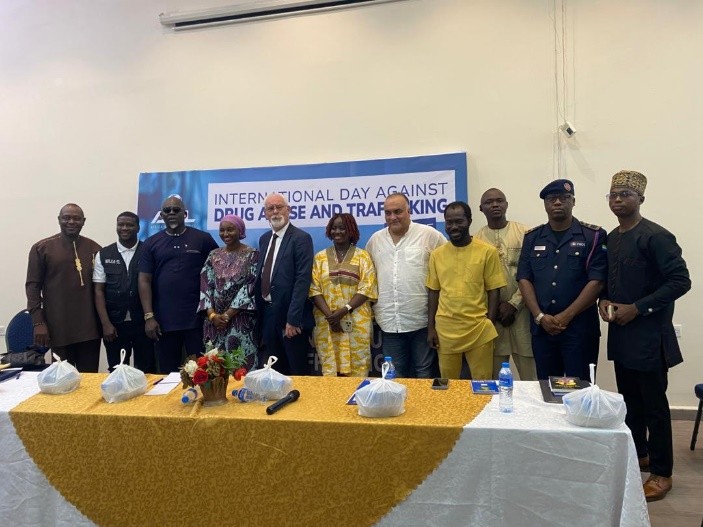
Freetown, Sierra Leone, June 26, 2026, Africa Global Logistics (AGL), through Freedom Terminal Limited, on Friday, 26 June 2026, joined the global community in commemorating the International Day Against Drug Abuse and Illicit Trafficking with a high-level awareness programme held at the New Brookfields Hotel in Freetown. The event brought together government officials, law enforcement agencies, port stakeholders, customs authorities, media representatives, civil society organisations, and members of the port community to reaffirm their collective commitment to combating drug abuse and illicit drug trafficking.
Welcoming participants, Abibu Jalloh expressed appreciation to the distinguished guests and representatives from various sectors who attended the event. He noted that the broad participation reflected the shared responsibility of all stakeholders in addressing the growing threat posed by drug abuse and trafficking.
Delivering the first presentation, Patrick Sannoh of Freedom Terminal Limited underscored the importance of maintaining a drug-free workplace, particularly within the country’s ports and logistics sector where safety remains paramount.
He said the International Day Against Drug Abuse and Illicit Trafficking serves as a reminder of the collective responsibility to create safer and healthier workplaces.
According to Sannoh, Freedom Terminal Limited and the AGL Group operate in a fast-paced, safety critical environment where every task requires alertness, sound judgement and teamwork.
“Safety is not just a priority it is the foundation of everything we do,” he stated.
He disclosed that Freedom Terminal Limited operates a strict Zero-Tolerance Drug Policy which prohibits the possession, use, consumption, distribution, sale or trafficking of illegal drugs within company premises or during official duties.
Sannoh also reminded employees and stakeholders that ports, airports and border crossings remain prime targets for international drug trafficking networks, urging workers to remain vigilant and immediately report suspicious activities, unauthorised movements, unusual cargo or breaches of established security procedures.
He encouraged participants to embrace three key principles: learning and sharing knowledge about the dangers of drug abuse, taking personal responsibility by complying with workplace policies and reporting suspicious activities, and supporting colleagues facing substance abuse challenges by encouraging them to seek professional assistance.
He warned that violations of the company’s Zero Tolerance Drug Policy could result in disciplinary measures, including dismissal from employment and referral to law enforcement authorities where necessary.
Sannoh concluded by stressing that prevention begins with awareness, awareness inspires action, and action creates safer workplaces and stronger communities.
Addressing the gathering, AGL Country Manager Captain Fabjanko Kokan reaffirmed his company’s unwavering opposition to drug trafficking and its devastating consequences.
He thanked members of the port community, government agencies, development partners and stakeholders for supporting the initiative.
Captain Kokan described drug trafficking as a destructive criminal enterprise that destroys families, weakens communities, fuels corruption, contributes to violence and robs young people of their future.
He emphasised that those involved in the illegal drug trade often pursue financial gain without recognising that money cannot buy respect, dignity, integrity or humanity.
The AGL Country Manager stressed that education remains one of the strongest weapons in the fight against drug abuse.
He revealed that he recently supported the construction of a school in a rural community because he believes education provides opportunities that reduce young people’s vulnerability to criminal exploitation and substance abuse.
“This is not simply my responsibility as a General Manager. It is my responsibility as a human being, as a father, and as a grandfather,” he said.
Captain Kokan further urged all institutions operating within the port community to strengthen cooperation, noting that ports serve as strategic gateways for international trade but are also attractive targets for organised criminal networks.
Calling for unity among stakeholders, he reminded participants that sustainable success can only be achieved through collaboration.
“One finger cannot lift a stone. Only by working together can we protect our ports, safeguard our communities and secure a better future for our children,” he stated.
The keynote address was delivered on behalf of the Executive Director General of the National Drug Law Enforcement Agency (NDLEA) by the Agency’s Director of Drug Prevention, Education and Training.
Speaking on the 2026 global theme, “The World Drug Problem: Past Challenges, New Threats and Innovative Responses,” the speaker observed that although progress has been made globally in addressing illicit drugs, criminal organisations continue to adopt increasingly sophisticated methods by exploiting technology, vulnerable populations, weak institutions and international trade routes.
He outlined four strategic pillars guiding the Agency’s national response.
The first pillar, he explained, is prevention through strong family values. Parents and guardians, he said, remain the first line of defence against drug abuse by instilling discipline, responsibility and positive values in their children.
The second pillar focuses on showing compassion to individuals suffering from substance use disorders while maintaining zero tolerance for traffickers, manufacturers, financiers and organised criminal networks.
He stressed that rehabilitation should be encouraged without stigma or discrimination, while law enforcement agencies continue pursuing those who profit from illegal drugs.
The third pillar centres on rehabilitation and social reintegration. He noted that government institutions, psychiatric facilities, faith-based organisations and development partners continue supporting treatment and rehabilitation programmes aimed at helping affected individuals return to productive lives.
He urged communities to welcome rehabilitated persons instead of rejecting them, warning that discrimination often increases the risk of relapse.
The fourth pillar focuses on strengthening law enforcement through intelligence-led operations, border security, international cooperation and coordinated investigations.
He revealed that the Agency continues conducting public destruction of confiscated drugs to demonstrate transparency and reassure citizens that seized narcotics are never returned to circulation.
According to him, from January to April 2026 alone, the Agency secured more than 48 convictions involving drug-related offences.
He concluded by emphasising that the fight against drugs cannot be left solely to law enforcement agencies but requires the active participation of families, schools, employers, communities and every responsible citizen.
A panel discussion involving representatives from the Customs Service Department, the National Revenue Authority (NRA), Freedom Terminal Limited, port security agencies and the Sierra Leone Border Agencies Association explored practical measures to strengthen efforts against drug trafficking.
Responding to questions from participants, the Customs representative explained that traffickers continually develop sophisticated concealment methods, particularly within shipping containers carrying legitimate cargo.
He noted that intelligence gathering, intelligence sharing and risk profiling remain Customs’ most effective tools in identifying suspicious consignments.
The Customs official further disclosed that while it is impossible to physically inspect every container entering the country, intelligence-led inspections and targeted examinations have resulted in numerous successful seizures.
He added that following an increase in the illegal importation of pharmaceutical products, Customs introduced mandatory physical examination of all containers declared as carrying medicines, leading to several successful interceptions of illicit substances hidden among legitimate pharmaceutical consignments.
Representatives from the National Revenue Authority highlighted ongoing investments in advanced cargo scanning technology, improved risk assessment systems and stronger collaboration with partner agencies to enhance border security and detect illegal imports.
Officials from Freedom Terminal Limited reiterated the company’s Zero-Tolerance Policy on drug trafficking, outlining security measures that include enhanced access control, strengthened perimeter security, employee awareness programmes, close collaboration with Customs and other security agencies, and continuous monitoring of terminal operations.
The company’s representative emphasised that assigning blame to individual institutions would not solve the problem, noting that Customs, the NRA, terminal operators, security agencies and community members all have shared responsibilities.
He encouraged stakeholders to focus on practical solutions through collaboration rather than criticism.
The President of the Sierra Leone Border Agencies Association also stressed that effective partnerships remain the cornerstone of successful anti-drug operations.
While acknowledging the importance of technology, surveillance systems and cargo scanners, he maintained that professional integrity, information sharing and inter agency cooperation remain the most powerful weapons against organised drug trafficking.
He urged all institutions to continue strengthening collaboration to protect Sierra Leone’s borders and communities.
Throughout the discussions, participants repeatedly emphasised that combating drug abuse and illicit trafficking requires collective action involving government institutions, security agencies, employers, educational institutions, religious leaders, families and ordinary citizens.
The event concluded with a vote of thanks delivered by Ajuah Daramy, who expressed appreciation to all speakers, panelists, stakeholders and participants for their valuable contributions. He commended AGL and Freedom Terminal Limited for organising the awareness programme and reaffirmed the importance of sustained collaboration in promoting drug free workplaces, safer ports and healthier communities across Sierra Leone.