



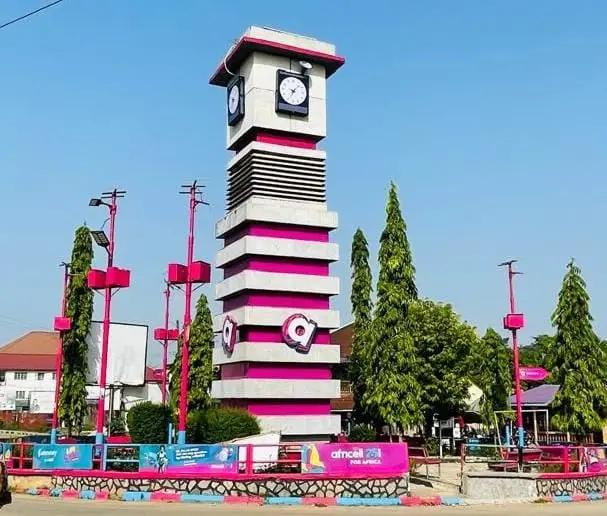
In a move that underscores the growing intersection between corporate influence and cultural preservation in Sierra Leone, Africell Sierra Leone has taken center stage in restoring one of the country’s most recognizable provincial monuments the Bo Clock Tower. The project, formally unveiled in a public ceremony in Bo City, signals a deliberate shift by private sector actors toward safeguarding national heritage while consolidating their relevance within local communities.
At the heart of the event was the Chief Executive Officer of Africell Sierra Leone, Shadi Gerjawi, who led the commissioning proceedings amid a gathering of city officials, traditional leaders, youth representatives, and residents. The atmosphere reflected more than a routine ribbon-cutting; it was a convergence of civic pride, historical reflection, and corporate messaging.
The Bo Clock Tower, which has long stood as a symbolic anchor in Sierra Leone’s second largest city, has witnessed decades of transformation from colonial administration through post independence evolution to modern urban expansion. However, like many heritage sites across the country, it had suffered visible deterioration over time, raising concerns about the gradual erosion of historically significant structures.
Africell’s intervention, therefore, was not merely aesthetic. According to project details shared during the ceremony, the renovation involved structural reinforcement, restoration of the clock mechanism, repainting, and improvements to the surrounding environment to enhance both durability and visual appeal. The aim was to return the monument to a state that reflects its historical value while ensuring its sustainability in the face of urban pressures.
Addressing attendees, Gerjawi framed the initiative within a broader corporate philosophy that extends beyond telecommunications. He emphasized that while Africell continues to expand its network infrastructure and digital services, its long term presence in Sierra Leone demands a deeper engagement with the country’s social and cultural fabric.
He noted that monuments like the Bo Clock Tower are not just physical structures but repositories of collective memory. By restoring such landmarks, companies can contribute to strengthening identity, continuity, and community cohesion elements often overlooked in conventional development narratives.
From a governance perspective, the initiative also highlights an evolving model of public private collaboration. The Mayor of Bo City Council, Kobba Musa, openly acknowledged Africell’s role as a development partner, describing the intervention as both strategic and timely. His remarks reflected a broader institutional recognition that municipal authorities increasingly rely on private sector support to address infrastructure gaps and maintain public assets.
While his endorsement carried a tone of appreciation, it also subtly pointed to the structural limitations facing local councils, particularly in financing maintenance of heritage sites. Africell’s involvement, in this context, becomes both commendable and indicative of the shifting responsibilities in urban management.
For residents of Bo, the impact is more immediate and emotional. The clock tower is not merely an architectural feature; it functions as a social landmark a meeting point, a navigational reference, and a symbol embedded in everyday life. Its restoration has therefore reignited a sense of ownership and pride among locals, many of whom view the facelift as a reclamation of identity rather than a corporate project.
Interviews conducted at the scene revealed a consistent sentiment: that modernization should not come at the expense of history. The renovated structure now stands as a visual reminder that development can be both forward looking and rooted in tradition.
Critically, Africell’s intervention also feeds into a broader narrative about corporate social responsibility (CSR) in Sierra Leone. Increasingly, companies are being judged not only by their service delivery but by their tangible contributions to societal well-being. In this regard, Africell’s portfolio spanning digital connectivity, youth initiatives, and now heritage preservation positions it as a multifaceted stakeholder in national development.
However, such initiatives also invite scrutiny. Observers note that while corporate led projects are beneficial, they should ideally complement, rather than substitute, state led preservation frameworks. Sustainable heritage conservation requires policy consistency, funding mechanisms, and institutional oversight that extend beyond individual interventions.
Nonetheless, the successful rehabilitation of the Bo Clock Tower represents a noteworthy case study in how targeted corporate action can yield visible and meaningful results. It demonstrates that even within a profit driven environment, there remains space for investments that prioritize cultural continuity and community identity.
As the ceremony concluded, the restored clock tower stood not just as a refurbished structure, but as a statement one that reflects the potential of strategic partnerships in redefining development beyond infrastructure and into the preservation of national memory.