



By Mackie M. Jalloh
An assessment delegation from the International Monetary Fund has engaged technical officials of Statistics Sierra Leone in detailed consultations aimed at evaluating the country’s macroeconomic data integrity and performance benchmarks under the Extended Credit Facility (ECF) arrangement.
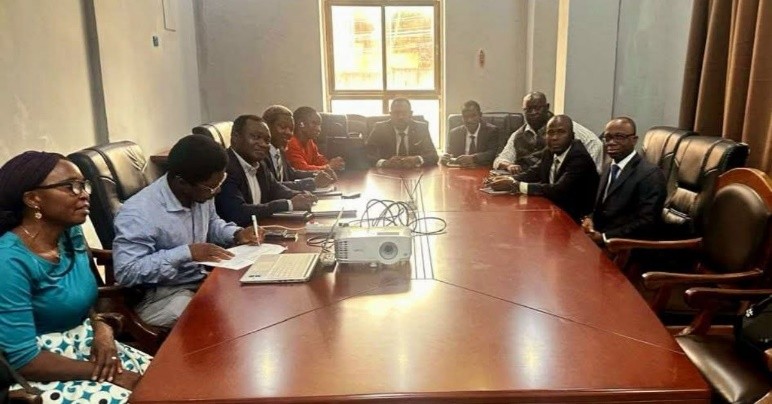
The discussions, held at the temporary headquarters of Statistics Sierra Leone at Kona Lodge on King Street in Freetown, formed part of the IMF’s broader surveillance and programme review mission. Rather than a ceremonial engagement, the meeting focused intensively on the quality, consistency, and reliability of Sierra Leone’s core economic indicators—particularly Gross Domestic Product (GDP) and the Consumer Price Index (CPI).
At the centre of the dialogue was the measurement of economic output across key productive sectors. Officials examined 2025 performance data from mining, agriculture, manufacturing, and related industries to assess growth patterns and sectoral contributions to national output. Given Sierra Leone’s heavy reliance on extractives and agriculture, the robustness of these figures remains critical to policy formulation and fiscal projections.
Mwaluma Andrew Brima Gegbe, Director of the National Accounts and Economic Statistics Division at Statistics Sierra Leone, provided technical clarifications on methodology, data compilation processes, and sectoral revisions. He highlighted ongoing efforts to enhance statistical systems, including improvements in data collection instruments and alignment with international statistical standards.
Inflation dynamics featured prominently in the review. IMF economists scrutinized recent CPI movements, underlying price pressures, and the broader implications for household purchasing power and business operating costs. Discussions extended beyond headline inflation to examine core inflation trends and price volatility across essential commodities.
Particular emphasis was placed on the development of quarterly GDP estimates—an initiative designed to improve short-term economic monitoring. Historically, national accounts reporting in Sierra Leone has relied heavily on annual aggregates, limiting policymakers’ ability to respond swiftly to emerging economic shocks. The introduction and refinement of quarterly GDP data are expected to strengthen economic forecasting and fiscal planning.
The IMF team’s mission is not limited to data validation alone; it also seeks to evaluate progress made under the ECF-supported reform agenda. The Extended Credit Facility programme typically requires adherence to performance criteria related to fiscal discipline, monetary stability, and structural reforms. Accurate and timely statistical reporting is therefore indispensable to assessing compliance and determining the trajectory of future disbursements.
While no formal conclusions were announced at the meeting, the engagement underscores the centrality of credible data in sustaining macroeconomic stability. Reliable statistics influence everything from budget formulation and debt sustainability analysis to investor confidence and international development support. The IMF delegation is expected to continue consultations with other key economic institutions, including fiscal and monetary authorities, as part of its comprehensive review of Sierra Leone’s economic outlook. The outcome of these engagements will likely shape policy recommendations aimed at reinforcing growth prospects, containing inflationary pressures, and maintaining macroeconomic resilience in 2026 and beyond.